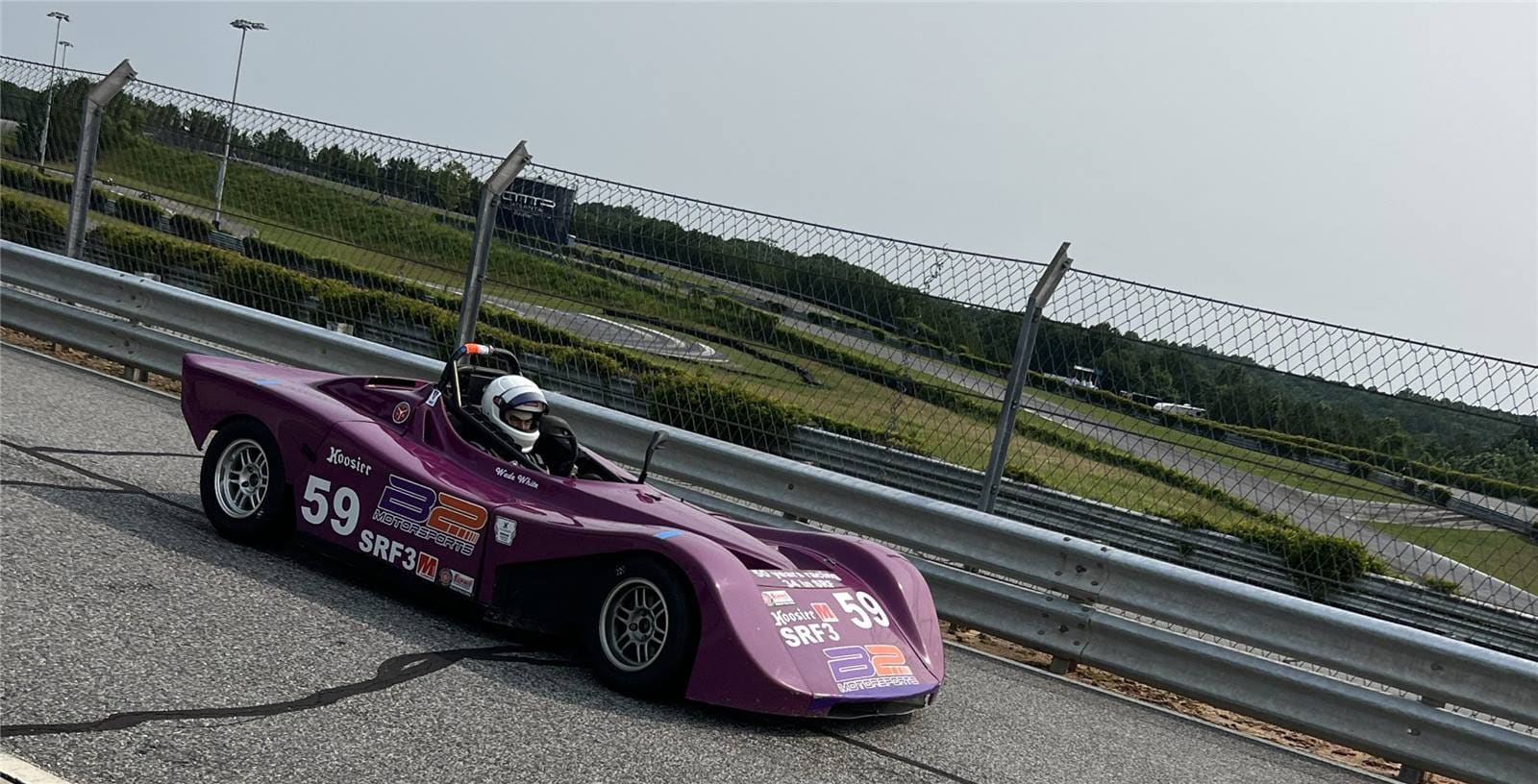
Getting started
How much does it cost to start racing? Every route, costed end to end
Nobody is ready for a Hoosier Super Tour the Monday after a license school. A license is a credential; speed and racecraft are hours. These are two different clocks, and almost all of the money follows the second one. Here is what each route actually costs, what you are holding at the end of it, and how to pick.
Every figure below is dated, sourced and reproducible. Where a competitor does not publish a number, we say so rather than estimating one.
The two clocks
The license is the cheap part
The lowest-priced school we found that ends in a Full Competition License with a car supplied is MSR Houston. Their three-day school in a rented Spec Racer Ford Gen2 is $4,450, and about $5,400 with SCCA membership, the license fee and travel (we costed the travel from Huntsville; yours will differ). If a Novice Permit is enough to start, PTC's two-day school in Fayetteville, TN is $3,625 with the car included. We rent Spec Racer Fords and we will still point you to a school if the license is all you want. Every school's price is on the license page.
But look at what you are holding when you walk out: a school certificate for a license, and somewhere between three and ten hours of track time. Getting a license is the easy part. Getting good is the hard part, and it is also the fun part.
The Hoosier Super Tour at Barber costs $795 to enter, requires a Full license, and has no test day. The gap between those two paragraphs is what this page is about. In plain terms: how much does it cost to start racing, and how much does it cost to be ready to race?
A Full license, car supplied
~$5,400
MSR Houston's three-day school in a rented Spec Racer Ford, with membership, the license fee and travel from Huntsville.
What it buys on track
3–10 hours
What a license route gives you on track before you're on your own.
Barber Hoosier Super Tour
$795 entry, no test day
What the tour you were training for actually asks of you.
The journey
Progress comes in plateaus
Getting good in a race car does not happen in a straight line. It comes in plateaus: stretches where it feels like nothing is changing, then a jump. The license is one small step in there. Here is roughly what the plateaus look like and how much seat time each one usually takes. You can start on the first one today with SCCA membership and a driver's license.
- Plateau 1
At home in the car. Track days and Time Trials: a real clock, no wheel-to-wheel. Most drivers stop thinking about the car and start thinking about the track within a handful of track weekends.
- Plateau 2
Racing, and finishing. A school and a Novice Permit get you onto a regional grid. The first few race weekends are about starts, traffic and bringing the car home; most people feel settled in a regional field after three to five of them.
- Plateau 3
Within a second of the fast drivers. This is pure seat time, and it is attainable: one to two years of steady running gets most committed drivers there. It's the most satisfying jump on the list, because the stopwatch shows it.
- Plateau 4
Racecraft. Strategy, tire management, where to pass and when not to, what to do on lap one with a full field around you. This takes longer than the speed did, and it is what separates a quick lap from a good result at a Major, a Super Tour or the Runoffs.
- And on
Your own measure. For some people that's a regional championship, for some a national podium, for some just a cleaner lap at their home track than last year. It's all progress, and every hour in the car adds to it.
What that looks like in real results
Ryan Starck races our SRF3 and came to the sport as an adult. In his earliest results we can find, late 2024 and spring 2025, he was roughly two seconds a lap off the fastest SRF3s. By summer 2025 he was within about a second at Road Atlanta, and at Atlanta Motorsports Park that June he set the SRF3 lap record and still finished third in class. That is plateau three arriving, and plateau four showing up right behind it: the fastest lap is not the same thing as the win. In 2026 he took on the Hoosier Super Tour, with fields of 38 to 47 cars, and finished anywhere from 14th to 39th, with his best result, 14th of 40, coming at Barber in August. Nothing about that is a setback. It is exactly what the journey looks like.
A teenage driver from the Atlanta area finished SCCA drivers' school in March 2025, won an SRF3 race at a SEDIV Major about 15 months later in a seven-car field, and then lined up for his first Runoffs that October, finishing 24th of 44, about five seconds a lap off the fastest laps. Quick in a small field, then a big step up against the best in the country: another plateau, another thing to learn.
You can start on the first plateau for about $5,000, right now, with no license at all.
- SCCA membership + region dues$100. A Time Trials Novice license needs only this and a driver's license.
- Talladega GP Time Attack entry$440 for two days
- B2 Spec Racer Ford, two days$4,488 for four hours on track, on scuffed tires, one of three cars in the trailer
- Out the door$5,028, or $1,257 per hour on track
212 miles round trip from our shop. You need no school, permit, medical form or experience. It does not earn license credit. Under GCR AppC.2.7.F a Time Trial can stand in for one of the three regional weekends, but only one run after you hold a Novice Permit. Come back for a Time Attack once you have the permit and that one counts.
Costed end to end
Six routes in, and what each one leaves you holding
These are complete out-the-door totals: school or entries, car, fees, license and the driving. The column worth reading is the last one. One thing to know before you read it: a Novice Permit already lets you race SCCA regionals. A Full Competition License opens the Majors and the Super Tour on paper, but it does not make you ready for them. Seat time does that.
| Path | Out the door | Track hours | Per hour | What you're holding at the end |
|---|---|---|---|---|
| A Full license from one school MSR Houston 3-day, rented Spec Racer Ford Gen2 |
$5,425 | not published | n/a | A Full license and a few hours in a Spec Racer Ford Gen2. Fuel and any damage are yours; a Gen3 rental is $4,800 to $5,100 instead of $4,450. The seat time a Major or a Super Tour asks for comes after. |
| Local school, then a Monday test in our SRF3 PTC Fayetteville 2-day + a one-day test at PTC in our SRF3 |
$6,446 | 2 + school | n/a | A Novice Permit, which is enough to race regionals, plus your first two hours in the car you'll race them in. The school costs less than MSR's and it is close to home if you live around Huntsville, Chattanooga or Nashville. Add the track's own fee, about $700 for a day at Polecat, paid to Polecat; confirmed on your quote. |
| Formula school Lucas Oil Basic + Advanced |
$11,423 | 8 | $1,428 | A Full license, learned in a paddle-shift formula car. The nearest venue is 378 miles round trip from our shop. |
| Local school, then two races PTC Fayetteville + 2 Barber weekends in our SRF3 |
$12,923 | 6 | $2,154 | A Novice Permit from the school, which already lets you race regionals, then two regional race weekends on record that convert it to a Full license. The races are the point; the license is what falls out of them. |
| Local school, then a TT and a race PTC + Talladega Time Attack + Barber, our SRF3 |
$13,390 | 7 | $1,913 | A Full license, using the Time Trial substitution. Everything inside 212 miles. |
| Every hour in the same car Buccaneer school weekend at Roebling + 2 Barber, our SRF3 throughout |
$15,483 | 10 | $1,548 | A Full license, three race weekends, and ten hours in the exact car you'll race. Roebling is 844 miles once; the school runs one weekend a year, in February. |
In every row above, roughly $4,000 to $5,400 of the total is the credential. Everything above that number is track time. And the more of it you buy, the cheaper the hour gets: $2,154 an hour at six hours, $1,548 an hour at ten. The real choice is how ready you want to be when you get there.
Components: SCCA membership $85 + region dues ~$15; Novice Permit $150; Full Competition License $125 (both as listed in SCCA's store at my.scca.com, read 11 Oct 2026). B2 rentals used, all from the rental calculator with three cars in the trailer and scuffed tires: PTC one-day test, 2 h over 4 sessions, $2,571 · Barber two-day race weekend, 3 h, $3,882 · Talladega GP two-day, 4 h, $4,488 · Roebling three-day, 4 h, $5,890. Entries: Barber Double SARRC $580 · Buccaneer Roebling $295 · Talladega Time Attack $440. PTC school $3,625. Transport costed from our shop in Huntsville. Hours count only time that is published; PTC and MSR do not publish school track time. Recomputed 11 Oct 2026.
The honest trade
The schools are cheaper. Here's what the difference buys.
A school day in a PTC, MSR Houston or Hallett car costs less than renting ours and towing it to a track. The arithmetic is two sections up. What matters is what the difference buys you.
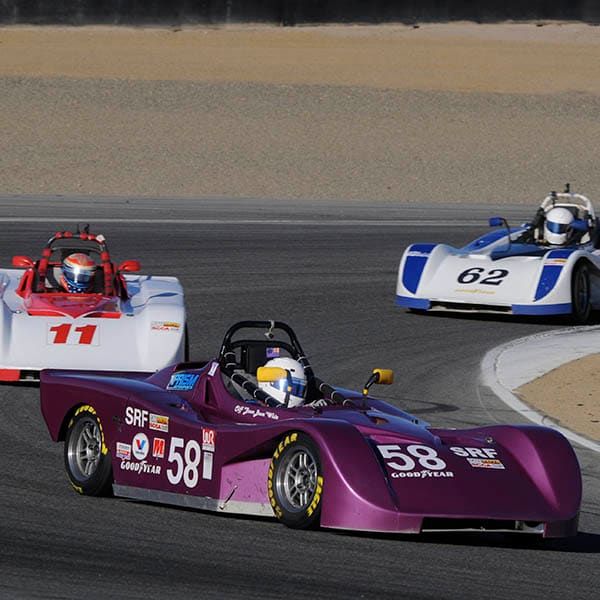
Seat time in the car you race
A school puts you in their car for two or three days, and many schools teach in a formula car or a sports car you are unlikely to race. The SRF3 is a sealed spec car: one SRF3 drives like another, and your own seat insert moves with you to any of them. So every hour in ours, from a Monday test to a Super Tour, builds on the last. Nothing resets.
The same crew, who know that car
The people who set the car up at Roebling are the people who set it up at Barber, and they remember what you asked for last time. When a customer put a rear corner into the wall at Mid-Ohio on a wet Saturday, the car was repaired and on grid Sunday morning.
Access to qualified coaches
Renting from us means access to our coaches, Cliff White and Mark Eaton, and to coaches in our network who know this car: Evan Slater, Morgan Burkhard and Dave Ogburn. At race weekends the debrief between sessions is part of it: data, video and a plan for the next session. Track days and time trials are arranged in advance for drivers who want to keep progressing; say so when you book and we'll build it in.
No truck, no trailer, no prep weekend
Be clear about who this is a difference from. A school also hands you a prepared car, so against a school it is a wash. Against owning your own SRF it is the whole difference: the car is transported, prepped, fuelled, run and put away, and you drive to the track. For anyone with a job, that often decides it more than the money does.
Three shapes
What a first year looks like, three ways
Find out if you love it
~$5,000
SCCA membership, a two-day Talladega Time Attack, our car for the weekend. Four hours on track, and all you need is SCCA membership and a driver's license. You'll know by Sunday afternoon. It doesn't count toward a license on its own, but every lap counts toward getting good. Want a coach there for it? Say so when you book.
License and first races
~$13,000
The PoleCat school, about an hour and ten minutes from our shop, a Novice Permit, then real race weekends in our SRF3 at Barber and Talladega. You finish with a Full Competition License, results on record, and six or seven hours in the car, with a coach debriefing you between sessions.
A full Super Tour season, east
~$34,000
All five eastern rounds of the 2026 Hoosier Super Tour in our SRF3: Road Atlanta, VIR, Mid-Ohio, Watkins Glen and Barber. Twenty-one hours on track at some of the best circuits in the country, priced weekend by weekend below. It needs a Full Competition License.
Out of curiosity
A full east-coast Hoosier Super Tour season, priced
The Hoosier Super Tour is SCCA's national-level series: nine weekends in 2026, two races each, and a Full Competition License to enter. We took the five rounds in the eastern half of the country and priced each one with the same arithmetic as our rental calculator, then added the published entry fee. We left out Buttonwillow, Portland, Hallett and Road America.
| 2026 round | Round trip | Days / track hours | Our SRF3 | Entry | Weekend |
|---|---|---|---|---|---|
| Michelin Raceway Road Atlanta 6–8 March | 436 mi | 3 / 5 h | $5,890 | $825 | $6,715 |
| VIRginia International Raceway 4–5 April | 1,044 mi | 2 / 3 h | $5,108 | $825 | $5,933 |
| Mid-Ohio Sports Car Course 15–17 May | 1,119 mi | 3 / 5 h | $6,983 | $780 | $7,763 |
| Watkins Glen International 19–21 June | 1,780 mi | 3 / 5 h | $7,897 | $980 | $8,877 |
| Barber Motorsports Park 29–30 August | 196 mi | 2 / 3 h | $3,882 | $825 | $4,707 |
| Five weekends | 13 / 21 h | $29,760 | $4,235 | $33,995 |
That is about $1,620 per hour on track, on scuffed tires. Run new Hoosiers every weekend and the season comes to about $38,100; ask about Toyo R888Rs if you would rather trade a little lap time for tire life. Optional test days are extra. We also offer multi-race discounts that depend on the size of the commitment and the terms, so if you are thinking about a season, ask us before you price it weekend by weekend.
Calculator inputs: three cars in the trailer; two-day weekends 3 h over 6 sessions, three-day weekends 5 h over 8 sessions; scuffed tires; transport, prep, trackside crew per day, tires, fuel and the car by the track hour, with crew hotel nights included where the tow runs over eight hours each way. VIR, Mid-Ohio and Watkins Glen distances are estimates (±15%) until we quote. Entries are the published 2026 fees plus the $30 SRF3 compliance fee: Road Atlanta $795, VIR $795 (Atlanta Region and NCR supplementary regulations), Mid-Ohio $750 (OVR supplementary regulations), Watkins Glen $950 (Finger Lakes Region registration), Barber $795 (Tennessee Valley Region registration). Schedule from scca.com/supertour, read 11 Oct 2026. SCCA membership and the Full license are not included.
Read the fine print first
The costs nobody quotes you
Most of these are ours to be straight about, and one is an industry problem.
Damage
The biggest unpublished cost in this category
Most racing schools say only that the student is "responsible for damages." Ours is in the open. Damage you cause is yours to pay for; a mechanical failure that is not your fault is not. The $6,000 crash-damage deposit is held while you race with us, and it is security, not a limit.
We show what that means in practice, with the common crashes we see and how each repair is billed: what a typical crash costs.
Safety gear
$1,000–1,600 for a legal minimum kit
Suit, helmet, head-and-neck restraint, arm restraints, shoes and gloves. It is a one-time cost that travels with you to every car and every track, so buy it once and buy it well.
We wrote the whole thing up, including what the GCR actually requires and where to buy it: buying safety gear.
Quotes
You'll be quoted differently everywhere, except here
On this site you can build a detailed, line-by-line quote yourself with the rental calculator. Almost everywhere else you call or submit a form, and the price that comes back grows once the number of days and the towing distance are added in.
We take that risk away by publishing how we price.
SCCA fees
Published, and small next to the driving
SCCA membership is $85 a year plus region dues. A Novice Permit is $150 and a Full Competition License is $125, both bought in SCCA's online store at my.scca.com once a school signs you off.
Call SCCA on 1-800-770-2055 if anything about your case is unusual.
Tires and fuel
Estimated up front, settled on what you use
We have run Spec Racer Fords long enough to know what they cost, down to these details. Our estimates assume scuffed Hoosiers, which is what most people run; a new set across a Barber weekend adds around $850.
You can always ask for a different tire strategy: new Hoosiers, used Hoosiers, or Toyo R888Rs, which last longer and run slower lap times.
Transport and prep
Every line is a specific job
Get ready: prep is getting the car ready, aligning it and fitting you in it. Get there: transport, charged once per event. Rent the car, by the hour on track. We do the work: the trackside crew, per day. You come, have fun and learn along the way.
That is why a single day looks expensive and a two-day weekend doesn't. Our benchmark two-day track weekend at Barber, two cars in the trailer, is $4,533.66, around $4,500.
Tell us where you are and where you want to go
For most of the people we race with, this is a personal journey of learning and accomplishment, and it doesn't run in a straight line. There isn't one right path. There's the one that fits how much time you have, how far you'll travel and what you want to be doing in two years. Tell us where you are and where you want to go, and we'll come back with the next step costed, even if the next step is a school we don't own.
Where are you in this?
We reply within a business dayinfo@b2motorsports.com · 2919A Bob Wallace Ave, Huntsville, AL 35805
Already know your car fits? Check your fit, or go straight to price a weekend. Want the whole rental picture first? Start at Race With Us. Questions answered plainly: the FAQ.