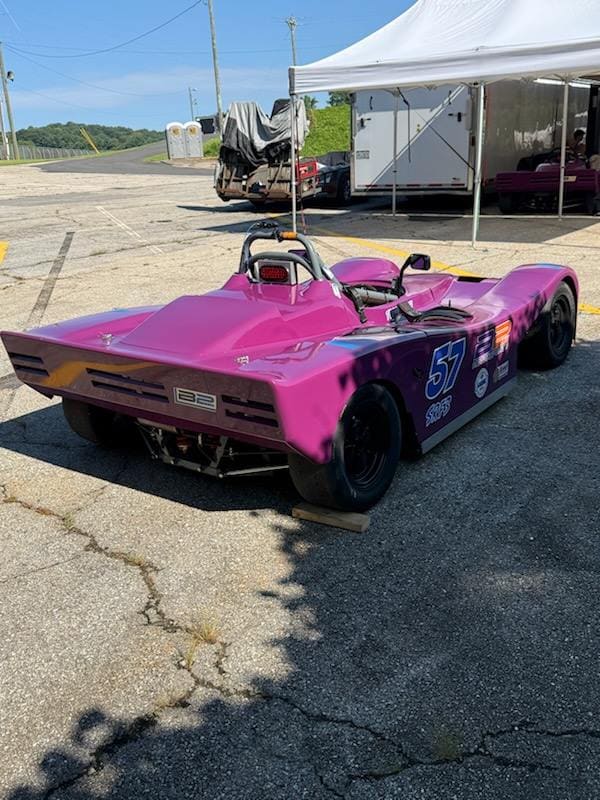
Every driver who gets in an SRF3, ours or their own, wears the same short list of gear. This guide walks through the SCCA safety gear requirements for a Spec Racer Ford, what a legal kit actually costs, and where B2 buys its own. Rules are quoted from the 2026 General Competition Rules, September build (V.09). Prices were read from the seller's own product page on 14 September 2026 and can move after that, so treat every number here as a starting point, not a quote.
What the SCCA requires
The SRF3 is an "open cockpit, single seat sports racer" (GCR 9.1.8.D), which sets the rules for an open car rather than a closed one: no window net, arm restraints instead. A scrutineer inspects your gear and stickers your helmet at your first event of the year (9.3.19.A), and everything below has to be "in good condition and free of defects, holes, cracks, frays, etc." (9.3.19.C).
- ✓Helmet
Snell SA2015 or newer (SA2015 stays valid through 2026), SFI 31.1/2015 or newer, or FIA 8859-2015/8860-2010 or newer, with the driver's name on the shell (9.3.19.C.2).
- ✓Head-and-neck restraint
SFI 38.1 or FIA 8858-2002/8858-2010 (9.3.19.C.3). A head-and-neck device does not time out on its own, but it has to stay in acceptable condition.
- ✓Suit
SFI 3.2A/1, SFI 3.4 or higher, or an FIA 1986, 8856-2000 or 8856-2018 label; fire-resistant underwear is required unless the suit already carries an FIA label or SFI 3-2A/5 or higher; one-piece suits are highly recommended (9.3.19.C.1).
- ✓Gloves
Leather and/or accepted fire-resistant material, no holes (9.3.19.C.4).
- ✓Socks
Accepted fire-resistant material (9.3.19.C.5).
- ✓Balaclava
Required for a driver with a beard or mustache; hair has to be fully covered under the helmet. Double-layer balaclavas are recommended (9.3.19.C.6).
- ✓Eye protection
Goggles or a face shield for drivers of open cars (9.3.19.C.7).
- ✓Shoes
Uppers of leather and/or nonflammable material, covering at least the instep (9.3.19.C.9).
- ✓Arm restraints
Required on all open cars, including open targa tops, sunroofs and T-tops (9.3.18). That is why an SRF3 needs them instead of a window net.
The GCR does not name Snell SA2025 or FIA 8859-2024 outright; both simply fall inside "2015 or later" and "or newer". It also gives no expiration for Snell SA2020, so we do not repeat the "good through 2030" line some retailers use.
Helmet fit, and where to try one on
A helmet is the one piece of gear you should never buy sight unseen if you can help it. Of the major auto-racing brands, only Arai publishes an interior shell shape, and it calls its current auto line "intermediate oval". Unlike its motorcycle line, Arai's car helmets come in no round-oval or long-oval option. Bell, Stilo, Zamp, OMP, Sparco and HJC publish nothing about shape; Bell's own fit page just warns that heads measuring the same with a tape "may not necessarily fit the same size helmet." A brand-by-brand shape chart circulates online from a single retailer, and its Arai entry contradicts Arai's own published spec, so we treat it as a conversation starter rather than a fact.
Size charts themselves are a reasonable starting point: a 58 cm head lands at M with Arai, HJC, OMP and Sparco, SML with Bell, and L with Stilo, whose own sizing page says Stilo helmets "run traditionally a hair smaller than other sizes on the market." Pads take up the last half-size. Most makers sell crown and cheek pads in a range of thicknesses, and sharp pressure at the forehead or temples is more often the wrong shell shape than a helmet that needs breaking in.
No retailer offers a fit guarantee on a worn helmet, so the safest route is trying one on before you buy. RacingDirect is in Huntsville and, in our own correspondence with them, welcomes local drivers to come in and try gear on; Discovery Parts (Dawsonville, GA, at Atlanta Motorsports Park), Competition Motorsport (Austin, TX), OG Racing (Sterling, VA) and Pegasus (New Berlin, WI) all publish similar walk-in or by-appointment fitting.
What a legal kit costs
Three budgets, before tax and shipping, all read from live product pages on 14 September 2026:
| Tier | Range | What it gets you |
|---|---|---|
| Legal minimum | $1,000–1,600 | The lowest-priced piece that clears every GCR spec above, nothing extra. |
| Buy once | $2,100–4,000 | A mid-tier suit and helmet you will not want to replace after one season. |
| No compromise | $5,200–9,700 | Top-tier everything: lightest suit fabric, premium helmet, FIA-rated gloves and shoes. |
| First weekend | $1,400–1,600 | Helmet plus an SFI-5/FIA package suit and gloves, with B2 lending the head-and-neck restraint and arm restraints. |
Prices read on 14 September 2026 · check the seller's page before you order
A few of the prices behind those ranges: the OMP First SFI-5/FIA package (suit, gloves and shoes) was $975 on sale, list $1,089.95, at RacingDirect; a Zamp RZ-63S Snell SA2025 helmet was $369.95 on sale; a Bell K1 Sport was $599.95. On the suit side, Sabelt's Challenge TS-2 was $799.95, the Universe TS-8 was $1,399.95, and the Hero Superlight TS-10 was $2,449.95, all at Sabelt America. Every price here was read on 14 September 2026.
If you want the lighter suit without paying for it in heat, look at fabric weight rather than layer count: Sabelt's two-layer Universe TS-8 runs 310 g/m², its three-layer Hero Superlight TS-10 runs 265 g/m². More layers does not automatically mean hotter. A single-layer 3.2A/1 suit still needs fire-resistant underwear under the GCR, so in practice it is two garments either way. We would rather you start with the lighter two-piece system than the cheapest single layer.
Gloves and shoes: your contact points with the car
SFI 3.3 grades gloves by the back of the hand (grade 1 is rated to 6 cal/cm², grade 5 to 19), requires the palm to cover at least 40 percent of the back-of-hand area, and rates the material itself regardless of how many layers it has, so layer count alone tells you nothing about the rating. Shoes get a single 19.0 cal/cm² floor with no grades. FIA 8856-2018 caps glove leather at 0.8 mm, keeps leather off the cuff, back of hand and fourchettes, requires an 80 mm minimum cuff, and requires a hydrocarbon-resistant sole on a shoe that covers the whole foot and ankle.
Our own preference, carried here as B2's recommendation rather than a rule: external-seam gloves with silicone palms for grip, and thin-soled shoes from the mid-to-upper price range so you can still feel the pedals. Sabelt's TG-10 glove is built, in the maker's words, to keep pressure points and bunching down when gripping the wheel; Alpinestars markets its reduced-print soles for a similar reason. Sabelt's Laser TB-3 shoe is worth a note: it is built for drivers and crew together, and Pegasus lists it under pit crew, so we point people at Sabelt's Classic TB-2 for driving instead. And do not assume racing shoes run small. The only manufacturer instruction we found (Simpson) says the opposite. Buy from a seller with easy returns, or try a pair on at the shop.
Reference prices, read on 14 September 2026: OMP Sport shoes ran $169–179, Sparco Slalom $209, RaceQuip 355 gloves around $75, and Sabelt's TG-10 glove $239.95.
Matching your helmet to your restraint
Your helmet needs M6 threaded terminals molded into the shell to take a head-and-neck restraint's tether posts. They cannot be added with a drill afterward, so a helmet without them has to go back to the maker or an approved installer. Both helmets named above have them: Zamp lists "M6 Terminal Hardware for easy use with HANS Devices" on the RZ-63S, and Bell lists the same on the K1 Sport.
Anchors themselves are sometimes in the box and sometimes not: a new HANS device ships with a set, Zamp's Z-Tech 8A restraint includes its anchors, Stand21's Club Series 3 does not (add about $60 for FIA anchors). Buying a spare set separately ran $41.22–$74.95 at Pegasus Auto Racing and $74.95 at RaceDay Safety, both read on 14 September 2026. Anchor posts are not interchangeable between styles (PA post, M61 quick-release and QC quick-click all differ), and Arai and Stilo use their own proprietary anchors, so buy for your specific helmet and restraint, not just "a HANS anchor."
Arm restraints, the radio kit, and tear-offs
Arm restraints come three ways: two separate lanyards, one connecting lanyard in a V, or sewn into the suit itself, in which case they live with that suit. The GCR's only real condition is that they cannot stop you signalling; SFI 3.3 sets a 1¾-inch minimum width at the arm and lap-belt ends, and the material itself does not have to be fire-resistant. Our own rule, not a published requirement: route the restraint between the belt and the buckle, so the lanyard cannot snag while you are trying to release the belt and climb out.
All of our cars carry radios, so the part you bring is the helmet kit. A 4-pin IMSA-style coiled cable ran about $200 at Racing Radios on 14 September 2026, with EZ-Install and straight-cord versions a little higher or lower. Skip the laminated tear-off stack: sprint racing rarely has you pulling more than one tear-off in a day, so a $33.99–$42.99 Pegasus laminated stack solves a problem most drivers do not have. Plain single tear-offs, in the $3.49–$19.95 range depending on pack size, cover a normal race weekend.
What about track days and time trials?
SCCA Time Trials sets its safety level by how the car is built, not by the event. Level 1 covers street cars and asks for little more than a helmet and closed shoes. Levels 2 and 3 add a suit rated FIA 8856 or SFI 3.2A/5 or better (a 3.2A/1 suit only with fire-resistant underwear), fire-resistant gloves and socks, and racing shoes. A purpose-built race car on non-DOT tires, which is exactly what an SRF3 is, must meet Level 3, and SCCA says outright that Level 3 is meant to be "similar to that of SCCA Road Racing." Open cars also need a full-face helmet. So a Time Trial in our car means the full suit, gloves, socks and shoes, the same as a race weekend. The two things Time Trials still only "highly recommend" are the head-and-neck restraint and arm restraints; we provide both to renters regardless. Most track-day organizers set their own bar lower still. We recommend wearing the full kit above for every on-track session, no matter what the organizer allows. One set of gear then covers a track day, a time trial and a race weekend, instead of three different standards to keep straight.
Time Trials rules read from SCCA's Time Trials safety pages on 11 October 2026
What we provide at the track
B2 provides the head-and-neck restraint and arm restraints for renters today. The radios built into the cars are ours; the helmet kit that plugs into them is yours to bring.
Where we buy, and how we get paid
B2 holds dealer accounts with some of the brands named in this guide. We recommend the same gear either way, and we will tell you when the cheaper option is the right one.
For helmets, restraints, gloves and shoes, the list we hand people locally is RacingDirect.com, in Huntsville. For suits, Sabelt America (sabeltamerica.com) is who we buy from ourselves.
Send us your measurements
Every supplier above sizes gear off the same handful of numbers: head circumference for a helmet, hand circumference for gloves, chest, waist, hips, inseam and sleeve for a suit, and plain shoe size for shoes and socks. Send us yours and we will help you read the size charts before you order. Fill in the form below or email info@b2motorsports.com with your height, weight, and helmet, suit, glove and shoe sizes.
Safety gear measurements
We reply within a business dayThe checklist
- ✓Helmet
Snell SA2015+ or SFI 31.1/2015+, name on the shell, M6 anchor posts if you are pairing it with a head-and-neck restraint.
- ✓Head-and-neck restraint
SFI 38.1 or FIA 8858, matched anchor style, provided by B2 for renters today.
- ✓Suit
SFI 3.2A/1 or higher, one-piece recommended, fire-resistant underwear if the rating calls for it.
- ✓Gloves and shoes
External seams and silicone palms on gloves, thin soles on shoes (B2's own preference).
- ✓Socks and balaclava
Fire-resistant socks always; a balaclava if you have a beard or mustache.
- ✓Arm restraints
Routed between the belt and the buckle, provided by B2 for renters today.
- ✓Helmet kit and tear-offs
An IMSA-style 4-pin cable to plug into our radios, plus plain single tear-offs.
Questions before you buy anything, or want us to check a size chart against your own measurements: read the rest of what to bring in our FAQ, or see the full arrive-and-drive program on Race With Us.